
A data architect designs and governs how an organization stores, moves, and protects its data. They turn business requirements into a technical blueprint, and data engineers build the systems from it, the way a building architect draws the plans and a construction crew pours the concrete. That is the short version. The rest of this guide covers the daily work, the skills, what the job pays, which certifications are worth the exam fee, and how analysts and engineers end up in the role. If you work with data tools, the link to your own work is direct: every dashboard in our data analysis dashboard guide sits on tables that someone designed first. For the foundations behind those tables, start with what data analysis is, and browse the rest of the Data Analysis section for related guides.
Designing a warehouse schema? Lay out fact and dimension tables in the Star Schema Designer → before you write any DDL.
What Is a Data Architect?
A data architect decides how data is organized before anyone builds anything. They define which systems hold which data, how those systems connect, what each field means, and who may touch it. The output is mostly documents and diagrams: data models, standards, integration maps, and a short list of approved technologies.
Take a company with a CRM, a billing system, and a web store. Marketing counts a customer as anyone who signed up for email. Finance counts a customer as anyone who has paid an invoice. Both numbers are correct and neither matches the other, so every revenue meeting starts with an argument about definitions. A data architect settles that once, in a shared model, and the argument stops.
The role sits between the business and the engineering team. The architect talks to executives about the decisions they need to make, then talks to engineers about how to store the data behind those decisions. Data architects usually report to a chief data officer, a head of data, or a CTO, and they work closely with the DBAs and engineers who carry out the design.
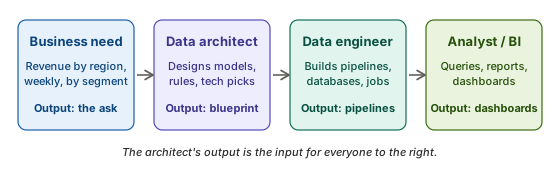
The building analogy holds up well. An architect draws the plans and writes the specification, and contractors build to it. Nobody expects the architect to lay bricks, and nobody wants the bricklayers improvising the load-bearing walls. Data teams work the same way, which is why data analysis goes faster once the architecture underneath it is settled.
What Does a Data Architect Do? Key Responsibilities
The daily work changes with company size. At a 50-person startup one person may do the architecture, the engineering, and the analysis. At a large bank, architects run whole teams. The core duties stay the same:
- Design conceptual, logical, and physical data models
- Set data governance standards for quality, access, and metadata
- Plan data pipelines and storage, including warehouses and lakes
- Design security controls and compliance-ready data structures
- Evaluate technologies and recommend the stack
- Work with engineers, DBAs, analysts, and business stakeholders
- Maintain documentation such as the data dictionary and data catalog
- Monitor system performance and set service levels
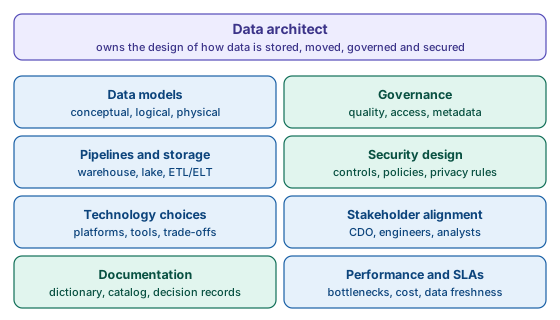
Data models come first. A conceptual model names the business entities, such as customer, order, and product. The logical model adds attributes and relationships. The physical model turns all of that into tables, keys, and indexes for a specific database.
Governance standards define what good data means. The architect writes the quality rules, decides who gets access to which datasets, and sets how metadata and lineage are tracked, so anyone can see where a number came from.
On pipelines and storage, the architect decides where data lands and how it moves between systems. That includes the choice of warehouse, lake, or both, and the ETL or ELT pattern that feeds them. Our guide to building a data warehouse follows one design from requirements through SQL, and the ETL Pipeline Mapper helps you sketch the flows before anyone writes pipeline code.
Security and compliance are a design problem for the architect. They specify encryption standards, role-based access, retention rules, and data structures that make regulations like GDPR, HIPAA, and CCPA practical to follow. Accountability for compliance itself is shared with security, legal, and compliance teams. The architect's part is making the compliant path the easy one.
Technology evaluation means comparing databases, cloud platforms, and integration tools against the organization's real workloads, then writing down why one was chosen. Our overview of data management tools shows what such a shortlist can look like.
Stakeholder work takes more calendar time than most people expect. Architects translate between a chief data officer's priorities and the engineers' backlog, and they field questions from analysts who found two columns that seem to mean the same thing.
Documentation keeps the design from living in one person's head. That means a data dictionary, a data catalog, and architecture decision records that explain why a choice was made. Read what a data dictionary is for the format, or produce a first draft with the Data Dictionary Generator.
Monitoring closes the loop. Architects watch for slow queries, storage growth, and failed loads, then adjust the design or push back on workloads that do not fit it. They also help define service levels, such as how fresh the data behind a dashboard has to be.
Data Architect vs. Data Engineer vs. Data Scientist vs. Data Analyst
Four roles touch the same data, and job titles blur the lines. The table separates them by what each one mainly does and produces.
| Data Architect | Data Engineer | Data Scientist | Data Analyst | |
|---|---|---|---|---|
| Focus | Designing data systems | Building data pipelines | Analyzing data for insights | Reporting on data |
| Primary output | Data models, architecture documents | Working pipelines and databases | Models, predictions, experiments | Reports and dashboards |
| Core tools | ER modeling tools, cloud platforms | Spark, Airflow, dbt | Python, R, Jupyter | SQL, Excel, BI tools |
| Typical experience | 5 to 8+ years | 3 to 6 years | Master's or PhD is common | 1 to 4 years |
| Average US salary | About $143,000 | About $120,000 | About $130,000 | About $80,000 |
Read the table left to right and you get the usual flow of a data project: the architect designs, the engineer builds, the scientist models, and the analyst reports. Real teams overlap more than the table suggests. Analysts often write production SQL, and engineers make design calls whenever no architect is around. The dependency still runs one way. A dashboard is only as trustworthy as the pipeline behind it, and the pipeline is only as sensible as the model it implements. What business intelligence is covers the reporting end of that chain.
Types of Data Architect
Data architect is a family of specializations. These five show up most often in job titles:
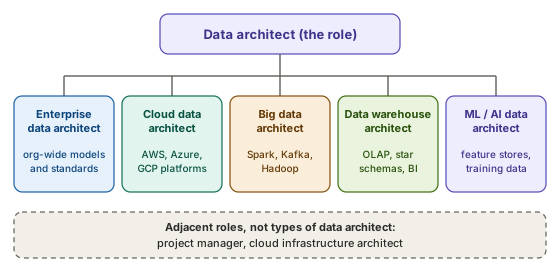
- Enterprise data architect: sets standards and the shared model across every business unit.
- Cloud data architect: designs data platforms on AWS, Azure, or Google Cloud, with attention to cost and managed services.
- Big data architect: designs distributed processing systems built on tools like Hadoop, Spark, and Kafka.
- Data warehouse architect: owns OLAP design, star schemas, and the BI layer. A first-draft schema takes minutes to sketch in the Star Schema Designer.
- ML/AI data architect: designs feature stores, training data pipelines, and the data side of model deployment.
Some guides list project managers and cloud infrastructure architects as types of data architect. They are separate jobs. A project manager coordinates the work and does not design data models. A cloud infrastructure architect designs networks, compute, and hosting, and the overlap with data architecture shows up only in the cloud data architect specialty.
Data Architect Skills
Eight skills come up in nearly every data architect job posting:
- Data modeling
- SQL and database design
- ETL and ELT pipeline design
- Cloud data platforms
- Big data technologies
- Data governance and metadata management
- Python scripting
- Business communication
Technical Skills
- Data modeling at the conceptual, logical, and physical levels, using tools such as ERwin, Lucidchart, or DbSchema
- Database design across relational (PostgreSQL, MySQL), NoSQL (MongoDB, Cassandra), and columnar systems (Snowflake, BigQuery, Redshift)
- SQL for schema design, complex queries, and query tuning
- ETL and ELT design with dbt, Apache Airflow, AWS Glue, or Azure Data Factory
- Cloud data platforms on AWS, Azure, and Google Cloud
- Big data technologies: Hadoop, Spark, and Kafka for streaming
- Governance and catalog tools such as Collibra and Alation
- Python for pipeline scripts and automation, with Java or Scala in some shops
- Enterprise architecture frameworks, mainly TOGAF and the Zachman Framework
SQL is the skill that never goes out of date. Every other tool on this list gets replaced every few years, but the relational thinking behind SQL carries over to all of them. Job postings sometimes put Oracle or Excel at the top of the requirements. Oracle is one database among many, and Excel is an analyst's tool, so read those as nice-to-haves and not as the core of the role.
Architects also need to know which types of data analysis their systems will have to support. A design for monthly reporting looks different from one built for ad hoc exploration.
Soft Skills
- Business translation: turning a vague request like "we need better customer data" into a precise specification.
- Communication: explaining a modeling decision to an executive without a whiteboard full of boxes.
- Strategic thinking: planning for where the business will be in three to five years, well past this quarter's reports.
- Political skill: getting two departments to agree on one definition of "active user" takes diplomacy as much as logic.
- Leadership: guiding engineers and DBAs through a design they did not draw themselves.
Data Architect Salary and Job Outlook
Salary sources measure different things, so the table labels each figure with its metric and date.
| Source | Metric | Salary | Date |
|---|---|---|---|
| Glassdoor | Average annual base salary, data architect | $142,986 | April 2025 |
| Glassdoor | Average annual base salary, data architect | $135,377 | July 2024 |
| US Bureau of Labor Statistics | Median annual wage, database architects | $135,980 | May 2024 |
| US Bureau of Labor Statistics | Median annual wage, database administrators and architects combined | $126,760 | May 2025 |
Glassdoor averages come from self-reported salaries, while the BLS figures are medians from an employer survey. That is one reason they do not match. Pay rises with seniority and with cloud specialization, and it tends to be higher in finance and healthcare and in large metro areas such as San Francisco, New York, and Seattle. Principal and enterprise architect titles sit above the numbers in the table.
You may see a much larger number quoted. ZipRecruiter reports some roles paying as high as $217,000 (2024). That is the top of the reported range, not a typical salary.
For outlook, the BLS groups database administrators and architects together and projects 4 percent growth from 2025 to 2035, about as fast as the average for all occupations. O*NET, which draws on the BLS 2024 to 2034 projections, lists database architects as their own occupation with 9 percent projected growth. Neither category is identical to "data architect," so treat both as indicators and not as a forecast for the title itself.
Data Architect Certifications
No certification is required for data architect roles, and experience with real designs counts for more. Credentials help most when you are moving into architecture from another job and need something concrete to point to.
| Certification | Full name | Issuing body | Focus |
|---|---|---|---|
| CDMP | Certified Data Management Professional | DAMA International | Broad data management, including data architecture |
| CDP | Certified Data Professional | ICCP (Institute for Certification of Computing Professionals) | General IT and computing |
| TOGAF | TOGAF Enterprise Architecture certification | The Open Group | Enterprise architecture framework |
| IBM Certified Data Architect, Big Data | IBM data architecture credential | IBM | Big data architecture on IBM platforms; confirm the exam is still offered |
| Salesforce Certified Data Architect | Formerly Data Architecture and Management Designer | Salesforce | Data design on the Salesforce platform |
| Cloud data certifications | Vendor data engineering and analytics exams | AWS, Microsoft, Google | Platform-specific data skills |
CDMP or CDP? The two acronyms get mixed up in many online guides. CDMP comes from DAMA International (dama.org) and covers data management broadly. CDP comes from ICCP (iccp.org) and covers IT and computing in general. They are different credentials from different organizations, so check the issuer before you register for either.
How to Become a Data Architect
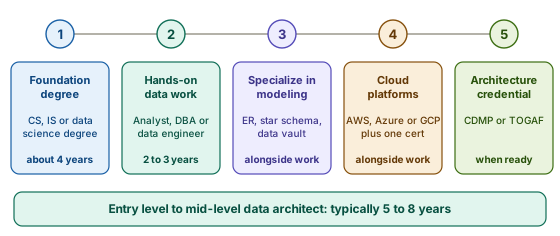
- Earn a bachelor's degree in computer science, information systems, data science, or a related field. Plan on about four years.
- Start in a hands-on data job as an analyst, database administrator, or data engineer. Two to three years is the minimum to see how real data goes wrong.
- Specialize in data modeling. Learn one modeling tool, then practice by designing star schemas and data vault models at work or in a personal project.
- Get comfortable with at least one cloud platform (AWS, Azure, or Google Cloud) and earn one of its data certifications.
- Add an architecture credential: CDMP for broad data management, or TOGAF if your employer thinks in enterprise architecture terms.
From an entry-level data job, expect 5 to 8 years to reach a mid-level data architect role and 8 to 12 years to reach senior or enterprise level. Those are typical numbers, not guarantees. An engineer at a small company can get there sooner because nobody else is doing the job. A good side project for step 3 is to work through the data warehouse build guide with your own data.
Tools Data Architects Use
Tools change faster than the design principles behind them, but these categories stay stable.
| Category | Tools |
|---|---|
| Data modeling | ERwin, DbSchema, Lucidchart, draw.io |
| Cloud data warehouses | Snowflake, Google BigQuery, Amazon Redshift, Azure Synapse |
| ETL/ELT | dbt, Apache Airflow, AWS Glue, Azure Data Factory, Fivetran |
| Big data processing | Apache Spark, Hadoop, Kafka |
| Governance and catalog | Collibra, Alation, Apache Atlas, AWS Glue Data Catalog |
| Databases | PostgreSQL, MySQL, Oracle, MongoDB, Cassandra |
| Programming | Python, SQL, occasionally Java or Scala |
| Analytics and BI | Tableau, Power BI, Looker, Amridata |
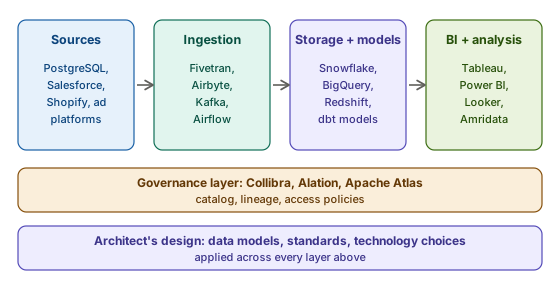
A practical way to learn these tools is to design a small warehouse by hand. Sketch the schema in the Star Schema Designer, paste the DDL into the SQL Schema Visualizer to check the ER diagram, and run your row counts through the Data Warehouse Sizing Calculator before you pick a platform. Map the data flows with the ETL Pipeline Mapper once the model holds up.
Automation is changing how much pipeline code gets written by hand. Our guides to data warehouse automation and data warehouse automation tools cover what to evaluate.
The dashboards and statistical analyses that tools like Amridata produce run on data that architects have designed and organized. A well-designed architecture is what makes fast, accurate analysis possible, and a poor one shows up as slow queries and numbers that nobody trusts.
FAQ: Data Architects
What is a data architect?
A data architect designs and governs how an organization stores, moves, and protects its data. They turn business requirements into data models, standards, and technology choices, and data engineers build the systems from that blueprint.
What does a data architect do?
A data architect designs data models, sets governance standards, plans how data flows between systems, designs security controls that support regulations such as GDPR and HIPAA, evaluates data technologies, and works with the engineers and DBAs who implement the design. They also maintain documentation such as the data dictionary and data catalog.
What skills does a data architect need?
Technical skills include data modeling, SQL and database design, ETL and ELT pipeline design, cloud data platforms (AWS, Azure, Google Cloud), and big data tools such as Spark and Kafka. Python is the usual scripting language. The soft skills that matter most are translating business needs into technical designs, communicating with non-technical stakeholders, and building agreement on data standards.
What is the average data architect salary?
Glassdoor reported an average US data architect base salary of about $142,986 per year in April 2025. The Bureau of Labor Statistics reported a median of $135,980 for database architects in May 2024. Pay varies with location, industry, and seniority.
What is the difference between a data architect and a data engineer?
A data architect designs the blueprint: the data models, governance rules, and technology strategy. A data engineer builds and maintains the pipelines, databases, and infrastructure that implement that design. Architects work at the strategic level and engineers at the implementation level.
What certifications help a data architect?
Common choices are the CDMP from DAMA International, TOGAF certification from The Open Group, vendor credentials from IBM and Salesforce, and data certifications from AWS, Microsoft, and Google. The CDMP is not an ICCP credential. ICCP issues the separate CDP.
How do you become a data architect?
Most data architects start with a bachelor's degree in computer science, information systems, or data science, then work as a data analyst, data engineer, or database administrator. They add data modeling skills, cloud platform experience, and often a certification such as the CDMP or TOGAF. Reaching a mid-level data architect role typically takes 5 to 8 years from an entry-level data job.
What is the difference between a data architect and a data scientist?
A data architect focuses on the systems and structures that store, organize, and govern data. A data scientist uses that data to build statistical models, run experiments, and generate insights. Architects design the infrastructure that data scientists depend on.
- U.S. Bureau of Labor Statistics. Occupational Outlook Handbook: Database Administrators and Architects. bls.gov. Median wages, employment counts, and the 2025 to 2035 projection.
- O*NET OnLine. National Employment Trends: Database Architects. onetonline.org. Growth figure based on BLS 2024 to 2034 projections.
- Glassdoor. Data Architect Salaries in the United States. glassdoor.com. Self-reported average base salary figures, dated in the salary table.
- DAMA International. Certified Data Management Professional (CDMP). dama.org. Issuer of the CDMP credential.
- Institute for Certification of Computing Professionals. Certified Data Professional (CDP). iccp.org. Issuer of the CDP credential.
- The Open Group. The TOGAF Standard. opengroup.org. Enterprise architecture framework and its certification program.